
01
28 written daily prompts — one page a day, every action spelled out
One-time program · 100% digital
Twenty-eight days to rebuild the basics — one written page a day, ten minutes, no app addiction and no 5am cult. Built for the person who has started eleven times and quit on Day 6, because this one is designed around the day you miss.
One payment. Run it forever.
28 written days · 4 weeks · 4 checkpoints
Nobody fails at fitness because the programme was wrong. They fail because Tuesday happened, then Wednesday agreed with it. This is the smallest system that survives Tuesday — written out, day by day, with the arguing already done.
01
28 written daily prompts — one page a day, every action spelled out
02
Four weekly checkpoints that score you on evidence, not vibes
03
The Never Miss Twice repair protocol for the day it all falls over
04
Diagrams: the streak grid, the habit stack, the friction dial and the miss-repair loop
05
Plain-English coaching — no productivity jargon, no 5am cult, no shame
06
Printable one-page tracker plus the full board inside the app
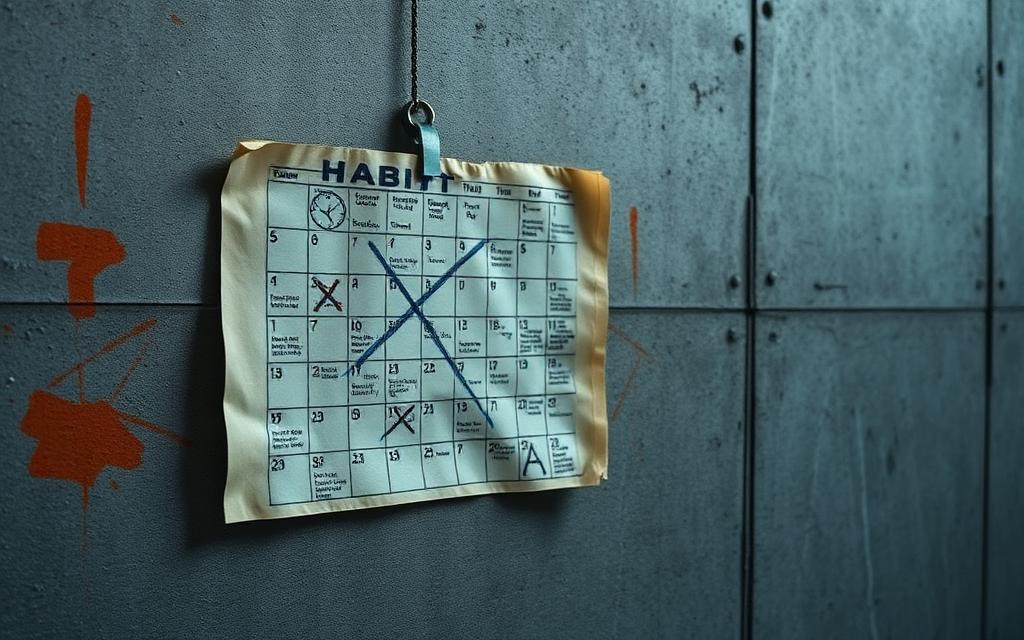
Four pictures that run the whole month. Nothing here needs a degree to read.
Filled = done. Red = a miss (Day 10). Acid = a planned rest (Day 19) — circled, not failed. Notice Day 11 is filled: never miss twice is the only rule that never bends.
Kettle on
Cue you never forget
10 squats
Keystone, tiny version
Fill the box
Proof, in ink
Coffee
The reward was already there
One cue, one decision, four behaviours. This is why stacks survive a bad week and reminders don't.
Every extra step between you and the habit is a day you'll skip it when you're tired. Day 4 removes two steps. That's the whole intervention.
The whole program lives or dies here. One miss is a data point; two in a row is a new habit pointing the wrong way.
Week 1 · Days 1–7
Before you add anything, delete the noise.
Most resets fail on Day 3 because people bolt eleven new habits onto a life that's already full. This week you subtract. You count what's actually happening, name the one habit that carries the rest, and make it laughably small.
The seven days
Non-negotiables
Checkpoint 1 — The Baseline
Standard: Pass = 4 or more boxes. Yes, four. Week 1 is about the wall grid existing, not perfection.
Day 1
The Honest Inventory
You cannot reset what you refuse to look at.
Why: You are collecting evidence, not judging it. The circle marks are where every later change gets installed.
If you miss: Do it tomorrow morning from memory. An imperfect inventory beats a perfect intention.
Day 2
Count, Don't Fix
Measurement changes behaviour before rules do.
Why: The observer effect is free leverage. People drink more water the day they start counting it, with zero willpower spent.
If you miss: Count tomorrow. Do not double up — nobody tallies two days at once.
Day 3
Pick The Keystone
One habit. The one that drags the others behind it.
Why: Keystone habits pay compound interest. Sleep fixes appetite; walking fixes mood; protein fixes cravings. Pick one and the rest get easier.
If you miss: Pick the one you avoided reading twice. That's usually the one.
Day 4
Kill The Friction
Willpower is a bad plan. Logistics is a good one.
Why: Every step removed is a day you'll still do it when you're tired. Motivation is weather; friction is architecture.
If you miss: Do one step, not two. One is the whole point of this program.
Day 5
Stack It
Attach the new thing to an old thing you never forget.
Why: Cues beat reminders. The habit you already do 100% of the time is stronger than any alarm.
If you miss: Stack it onto brushing your teeth. Nobody skips that.
Day 6
The Minimum Viable Day
Design your worst day now, while you're calm.
Why: Streaks die on chaotic days, not lazy ones. A pre-written floor means the chaos day still fills a box.
If you miss: Today was probably the bad day. Do the two-minute version now and write it down after.
Day 7
Checkpoint One
Score the week on evidence.
Why: Weekly review is the difference between 28 days and 28 disconnected attempts.
If you miss: Score it Monday morning with coffee. Never skip a checkpoint — it's the steering wheel.

Week 2 · Days 8–14
Boring, repeatable, unglamorous. That's the flex.
Week 2 is where novelty dies and the habit becomes furniture. You add exactly one supporting habit, you learn the repair protocol, and you tell one human being what you're doing — because private goals are the easiest ones to quit.
The seven days
Non-negotiables
Checkpoint 2 — The Floor Test
Standard: Pass = 9 of 14 and no double miss. Double misses cost more than a low score.

Week 3 · Days 15–21
The habit exists. Now make it worth something.
This is the week people quietly coast. So we raise the standard exactly once, add a hard-day plan, and start attaching the habit to identity instead of outcome. No new habits — better ones.
The seven days
Non-negotiables
Checkpoint 3 — The Overload Test
Standard: Pass = 15 of 21 and a difficulty score lower than Day 1. Easier is the real result — easier means automatic.

Week 4 · Days 22–28
Finish it, then build the thing that outlives it.
The last week isn't a sprint to Day 28 — it's you writing the operating system you'll run in month two. Bulletproofing, a stress test, a full audit and a signed 90-day plan on the last page.
The seven days
Non-negotiables
Checkpoint 4 — The Handover
Standard: Typical 28-day outcome: 21+ boxes, a keystone that runs without negotiation, and two habits you no longer think about.
Tap a term. No self-help jargon survives this page.
A pen, a wall and ten minutes. That's the whole requirement.
10–20 minutes a day. That's the whole ask.
We sell no equipment or supplements — this is a digital program only.
Try the free habit tracker firstTwenty-eight days from now is coming anyway
Instant digital access to all 28 written days, every diagram, the glossary and all 4 checkpoints. Keep it, run it again on a new keystone.
Educational programming, not medical advice. Clear new training with your doctor.